Saturday, May 30, 2015

Minimum Wage for Thee, but Not for Me

It has been reported that the president of the L.A. Federation of Labor, Rusty Hicks, made a last minute plea to the Los Angeles City Council, to allow any company that unionizes to be exempt from the city's new minimum wage law that mandates an increase to $15/hr. by 2020. This is the very minimum wage law they helped to pass. It seems that union leaders recognize economic law after all. I explain the economics of the minimum wage in my book, Foundations of Economics: A Christian View. My summary of the effects of the minimum wage are as follows:
At best it benefits some workers at the expense of other workers. Some lower-skilled workers will get paid more, while the lowest-skilled workers are left unemployed. Even higher-skilled workers can benefit from effective minimum wages, however. Unionized forklift operators, for example, benefit when stock boys are kept out of work because of above-market minimum wages. Those who are kept out of a job earn lower incomes over time because it takes them longer to develop job skills. Society in general is worse off because they have fewer goods available for which they must pay higher prices. Once again, the result of government intervention is exactly the opposite of what proponents of such intervention say they intend. An effective minimum wage does not reduce poverty. Rather, it places obstacles in the path of lower skilled workers in their quest to improve their lot in life.

I also argue that minimum wage laws violate Christian ethics:
Minimum wage laws prohibit some workers and entrepreneurs from making mutually beneficial work agreements. Some workers, who are not productive enough to warrant employment at the artificially high wage, are prohibited from exchanging their labor as they see fit. Some workers benefit at the expense of the least productive. Because price controls violate the Christian ethic of private property, they must be rejected as a means of achieving a better society.
The Christian property ethic does not allow for using the power of the state to keep people from entering into voluntary contracts. Christians are called to be charitable to those who need it and to be merciful to the poor and to see that widows and orphans are not oppressed. Justice demands, however, that people use their own resources to help those in need and to convince others voluntarily to do so. Lobbying for government price controls violates the right to property and therefore violates the Christian ethic.

This is not the first time an organization lobbying for the minimum wage requested to be exempt from it. In 1995 ACORN sued sued the state of California for exemption from paying the minimum wage to its own employees. ACORN argued before the court that "The more that ACORN must pay each individual outreach worker—either because of minimum wage or overtime requirements—the fewer outreach workers it will be able to hire."

Monday, May 25, 2015

Jeff Herbener on Microeconomics on the Tom Woods Show

A week and a half ago, my friend and department chair, Jeffrey Herbener, is the guest on The Tom Woods Show. In this program, he responds to criticisms of Austrian economics and particularly microeconomic analysis, largely based on Bryan Caplan's article "Why I am not an Austrian economist." In this interview, Herbener elucidates some of what sets Grove City College's economics department apart from others. It is well worth your time.


Tuesday, April 28, 2015

The Federal Reserve: Economics and Ethics

I was again blessed to be a guest of Dan Elmendorf on his radio program A Plain Answer, a program produced and broadcast on the radio stations in the Redeemer Broadcasting network. In this interview we discuss the nature and history of the Federal Reserve System. I also talk about the economics and ethics of central banking and government money production. I thought my exposition a little choppy, but not incoherent. My goal was to introduce the topic of the Federal Reserve to interested parties who perhaps have little knowledge of our central money making machine. You can imagine how broad brush I needed to paint in twenty-seven minutes. In any event, you can hear how I did by clicking here.

Tuesday, April 7, 2015

Myths about the Gender Wage Gap

Abigail Hail has a helpful post on The Beacon, the blog for the Independent Institute about the alleged gender wage gap, what she calls "a myth that just won't die." She rightly calls us to get the analysis straight before making political hay from a pet statistic that does not tell the whole story. As Hail notes,
The first thing to notice is that the “77 cents on the dollar” metric isn’t comparing apples to apples. It is a comparison of gross income. That is, it compares the income of all women to that of all men. It fails to take into account important factors—like education, experience, or even just comparing people in the same career. You wouldn’t compare the incomes of elementary school teachers with Bachelor’s degrees to those of individuals with PhDs in physics and complain that there is a “teacher-physicist wage gap” —but this is precisely what this statistic does.

When you take these characteristics into account, the purported “gap” all but disappears.

She then concludes by noting that a lot of the rhetoric that comes from the advocates of state intervention is rather condescending toward the very ones they claim to help.
Now, some will point to the statistics on the careers men and women tend to choose and say that women aren’t really “free” to choose their careers. This is not only incredibly patronizing, but ignores the fact that women in the U.S. are not only well educated, but also well-informed when it comes to selecting our careers. It’s not as if women are unaware that social workers and schoolteachers tend to earn less than engineers. We choose careers just as men do. We consider what we think is most important when selecting a career, look at our options, and make the best choices we can.

When it comes to issues of gender equality, there are a variety of issues to discuss. When having these discussions, however, it’s important for women and men to discuss the facts and present correct information. Otherwise, we not only perpetuate incorrect information, but we ultimately fail to advance these issues in any meaningful way.
I am very happy to see Hail's contribution to the debate, because she affirms many of the points I noted many years ago when I wrote on the same issue. Back in 1999 I came to the same conclusions.
All of this demonstrates that the performance of women's earnings over time is not the result of systematic discrimination. Whether egalitarians like it or not, for the "average" woman family life trumps other concerns on the margin. Employers and employees are merely recognizing this fact of nature: women and men are not equal in the sense of being identical. They are different and have different comparative advantages when it comes to work outside the home versus child rearing.

Of course, both men and women would like to work for much more than what they are getting paid, other things equal. But then, the other things are never equal. That fact serves as a useful device for egalitarian politicians and bureaucrats. Social engineers use the persistence of inequality of income as the warrant for never-ending regulation.

Monday, March 30, 2015

Bernanke On the Defensive

Perhaps due to essays like mine, Ben Bernanke is on the defensive asserting that the Federal Reserve "didn't throw savers under the bus" as it drove the Federal Funds rate to virtually zero. Bernanke cites unnamed economists who argue that the natural rate of interest has fallen over the past two decades. On the one hand, I suppose we should be thankful that Bernanke recognizes there is something like a natural rate of interest that is not controlled by the Fed. On the other hand, the idea that it is zero seems unlikely. In light of Austrian Business Cycle Theory, it is not true that holding the interest rate artificially low promotes a healthy economy. Here is another example of how Fed rhetoric does not match economic reality, the subject of my contribution to The Fed at One Hundred: A Critical View of the Federal Reserve System.

Tuesday, March 17, 2015

Government Deficits All the Way Up

A well-known scientist (some say it was Bertrand Russell) once gave a public lecture on astronomy. He described how the earth orbits around the sun and how the sun, in turn, orbits around the center of a vast collection of stars called our galaxy. At the end of the lecture, a little old lady at the back of the room got up and said: "What you have told us is rubbish. The world is really a flat plate supported on the back of a giant tortoise." The scientist gave a superior smile before replying, "What is the tortoise standing on?" "You're very clever, young man, very clever," said the old lady. "But it's turtles all the way down!"  —Stephen Hawking, A Brief History of Time
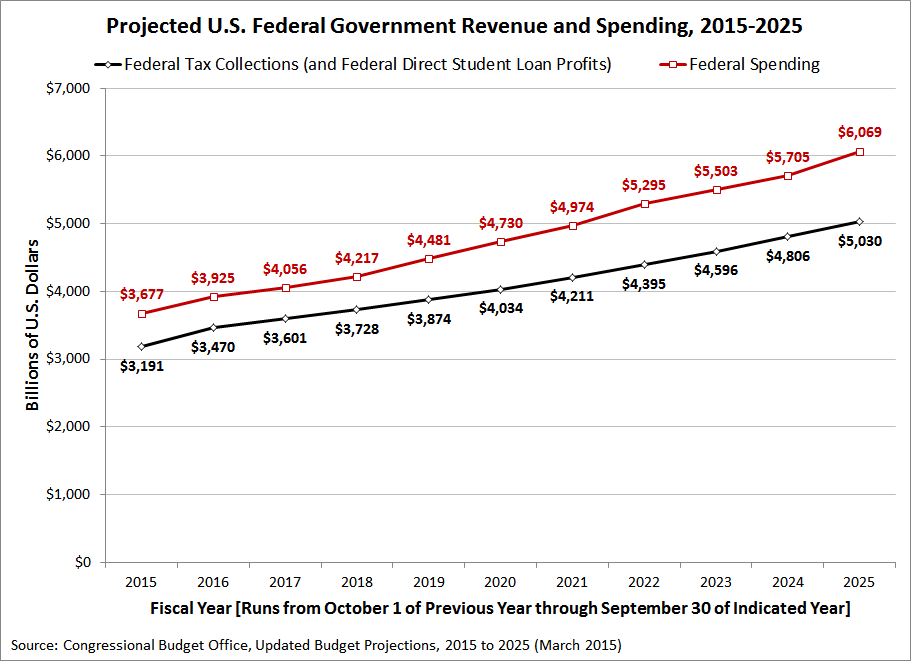
According the the scientist, it may be turtles all the way down, but with fiscal policy, the Congressional Budget Office informs us that for the next ten years, we can expect budget deficits all the way up.


Notice that the expected gap between spending and revenue widens as the years go by. This does not bode well for our economic future. Government spending is a tax of resources taken out of private hands and consumed by government bureaucrats. Such consumption hampers, not facilitates, economic prosperity.

Friday, March 13, 2015

What Did My Parents Ever Do to the Federal Reserve?

That is the question I am left asking after considering various claims about the supposed worrisome consequences of lower prices. David Blanchflower calls price deflation "a major economic pandemic spreading thoughout the world." Justin Wolpers likewise warns us of deflationary expectations. Financial advisor Bert Whitehead asserts, "we really have a danger of deflation world-wide." The solution for those who share the fear is always the same, create more money, stimulate more spending, and higher prices will follow. Bank of England Governor Mark Carney soothes deflation worries, for example, not by acknowledging that falling prices are not socially harmful, but by assuring us that Europe will get back to price inflation soon.

As I said, after all of this chatter, I am left wondering about the ethics of purposely reducing the purchasing power for those who have worked hard and saved all their lives. Higher prices do not, in fact provide prosperity, but instead result in increasing economic hardship for people like my parents. In my latest column for the Grove City College Center for Vision and Values I conclude:
. . .Mom and Dad had the foresight and character to make the sacrifices necessary to stay out of debt. Indeed, they are Paul Krugman’s worst nightmare—a family determined not to live beyond their means. Now retired, like many in their generation they are enjoying life the best they can on an almost fixed income. Because they have no debt, they have been able to live without tremendous economic hardship thus far. The Federal Reserve’s inflationism, however, increasingly makes life for them more difficult as steady price inflation daily chips away at their livelihood. Since 2009, for example, the Consumer Price Index has increased over nine percent. This masks, however, significantly larger price increases for important necessities. Prices of dairy products are up almost 17 percent since 2009. Gasoline prices are up almost 11 percent despite the recent decline. Prices for meat, poultry, fish, and eggs have increased a whopping 26 percent since 2009. Higher overall prices do not help people like my parents at all. They instead act as a thief, snatching wealth away from them in the form of diminished purchasing power. What they long for is to see the value of their savings increase. Far from creating economic hardship for them, lower overall prices would be a boon.

Both sound economics and ethics, therefore, demand that we give up the anti-deflation rhetoric and the inflation it fuels. Charity demands that we cease striking fear into the hearts of the masses, softening them up for ever higher prices. The Federal Reserve should stop punishing people like my parents who have worked hard and played by the rules their whole lives. After all, what did they ever do to Greenspan, Bernanke, and Yellen?


Read the rest here.